


What is STEAM Education?
See why this arty yet analytical learning approach is so great for your young child.
BY HEJIRA CONVERY, KINDICARE
STEAM education sounds perfect if your preschooler is obsessed with Thomas the Tank Engine and real-world railways, but your child doesn’t need to be a train buff to benefit from STEAM.
This educational approach is amazing for all early learners, and to get you up to speed, here is a quick explanation of what STEAM actually is, and why it’s positive for your child’s physical, cognitive, social and emotional development.

So, here goes!
STEAM stands for Science, Technology, Engineering, the Arts and Mathematics, and it’s a holistic approach that connects the different subjects, rather than teaching them one-by-one.
This is great, because it means children get opportunities to think logically and creatively at the same time.
And although there are some fantastic toys that support STEAM learning, like MAGNA-TILES®, STEAM activities can also be very DIY, with fun projects and experiments in the mix.
A STEAM activity might incorporate two or three of the five subjects, or all of them, and the activity will have that Art element, because this is what distinguishes a STEM activity from a STEAM one.
So, for example, counting out lumps of play dough and joining them into a creative structure using paper straws, is a STEAM activity that combines Maths, Engineering and Art.
And there’s Science and Art involved when you make a fizzy galaxy picture using baking soda, vinegar, food colouring and paper.
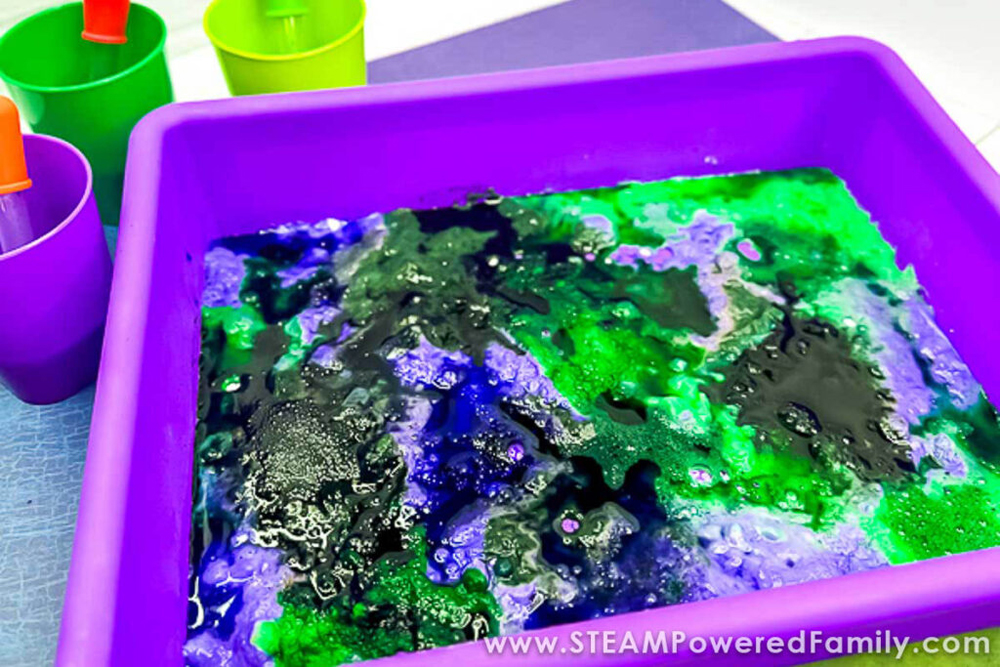 Photo: Steam Powered Family
These are just two examples, though. There are zillions of STEAM activities to explore, and whatever form it takes, STEAM education is really beneficial in early and later life.
Dr Amanda Gummer’s Good Play Guide says, ‘Research shows there is a positive relationship between early STEAM experiences and future success in school,’ and STEAM education teaches children a lot about themselves and the world.
The Good Play Guide explains that STEAM education benefits young learners in these wonderful ways:
1. It cultivates curiosity.
STEAM learning gives children lots of opportunities to explore, experiment and discover in an open-ended way. There’s no one answer or single approach with a STEAM activity, so children are free to express themselves and think in innovative ways.

2. It makes learning fun.
So, children are excited to be involved with STEAM activities. They feel good when they bring their plans and ideas to life. And they enjoy drawing, pouring, stacking, sticking and doing all those other STEAM-related things that build fine motor skills in an analytical, and also artistic, way.

3. It encourages critical-thinking and problem-solving.
With Science, Technology, Engineering, the Arts and Mathematics all in the mix, there’s lots of information for young minds to make sense of, and tricky problems to solve.
Children find themselves observing, asking questions and making predictions independently, but there’s teamwork involved too, and STEAM is great for children’s language skills, listening skills and collaborative skills as they think and work together.

4. It teaches children to learn from their mistakes.
Seeing that block tower wobble and fall, or that experiment ending up a fizzer, builds children’s resilience.
They understand that they need to try, and try again – which is a great mentality for life – and learning from their mistakes means thinking about what didn’t work, and coming up with strategies that might!

All in all, STEAM education is really positive for your young child, both at home and in the early learning space.
Whether you’re still researching childcare centres, with the help of KindiCare, or your child is already enrolled at an early learning service, quality educators will be happy to explain how STEAM education is woven into their curriculum – and this kind of learning has big upsides for your little one.