
What is the NQS Rating?
The NQS childcare rating makes it easier to spot a quality education and care service in your search results. Here’s a rundown of what it means, and how to use it.
BY HEJIRA CONVERY, KINDICARE
As a parent, you’ll know what ASAP, ATM and NSW all stand for, but if you’re at the start of your early learning journey, NQS might not be so obvious.
So, let’s clear things up.
In simple terms, NQS stands for National Quality Standard, and it aims to ensure the highest quality of education, care and safety for our children.
This means the NQS is closely tied to the EYLF (Early Years Learning Framework) that services are guided by when educating little Australians.
And it’s part of the NQF (National Quality Framework) that’s all about regulation, assessment and quality improvement for education and care services.

The NQS sets a high national benchmark that childcare services in Australia are assessed against, and this is where the NQS ratings come in.
Long day cares, preschools, kindergartens, family day cares and outside school hours care services all get assessed and rated against the NQS – no matter where they are, or what they’re offering.
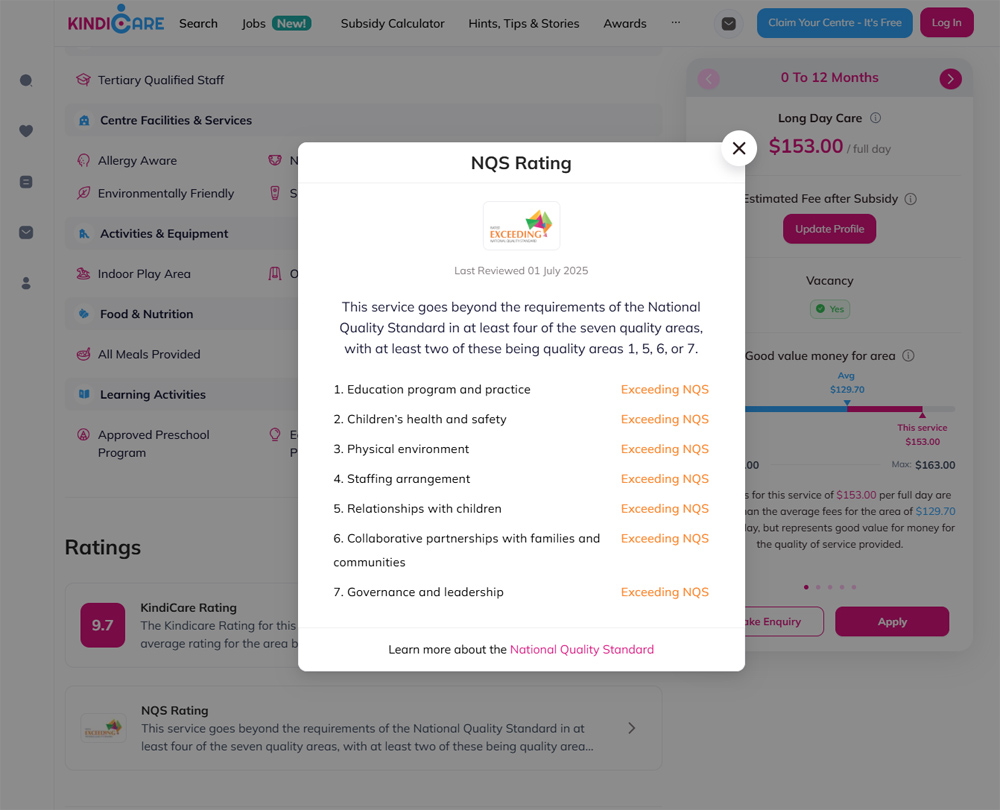
The process is undertaken by each service’s state or territory regulatory authority, and authorised officers assess services against these seven NQS quality areas:
- Quality Area 1: Educational program and practice
- Quality Area 2: Children’s health and safety
- Quality Area 3: Physical environment
- Quality Area 4: Staffing arrangements
- Quality Area 5: Relationships with children
- Quality Area 6: Collaborative partnerships with families and communities
- Quality Area 7: Governance and leadership
You can deep dive into each quality area here, but every one of them aims to get a great outcome for children by supporting their individual learning and development needs.

Services are given one rating for each quality area, and then get an overall rating based on those seven results.
This means the NQS provides a kind of report card for childcare services, with each quality area being a subject, and a final grade being given.
But instead of results like A+ or B-, there are five NQS rating levels:
- Significant Improvement Needed
This is not a rating you want to see in your childcare shortlist, because it means there are serious concerns about the service, and its regulatory authority is about to take action.
- Working Towards National Quality Standard
Although it doesn’t sound amazing, this rating means that the service provides a safe education and care program, but there is room for improvement in one or more areas.
- Meeting National Quality Standard
This is a really common rating, and it means that the service meets the NQS and provides quality education and care across all seven quality areas.
- Exceeding National Quality Standard
This rating is great to see, because it means the service goes above and beyond in at least four of the seven quality areas, with at least two of these being Quality Areas 1, 5, 6 or 7.
- Excellent
An Excellent rating is super exciting. It means the service is rated Exceeding NQS in all seven quality areas, and this overall rating is awarded by the Australian Children’s Education & Care Authority and incredibly hard to get.
There are less than 25 current Excellent rated services in Australia, so you probably won’t see one in your search results, but if you do, book a tour!

Services have to display their NQS rating, whether it’s good or bad, and KindiCare is transparent too.
An overall NQS rating appears on each KindiCare search result.
And when you open a childcare listing, you can drill down on the NQS rating the service has received for each quality area.
It’s also possible you’ll see a rating of Provisional – Not yet assessed under the National Quality Framework, and this is ok.
A Provisional rating just means the service is new and hasn’t been assessed and rated yet.
This will usually happen nine to 18 months after the service starts operating.
And until that final NQS rating appears, you can still think about the different quality areas when visiting a prospective centre.
Services also self-assess with something called a QIP, or Quality Improvement Plan
Approved providers must ensure that each service has a QIP, and this is a living document that involves consultation, reflection and forward-planning.
As part of the QIP, providers self-assess how well the service is delivering quality education and care, and where there’s room for improvement.
This is helpful for both the service and the regulatory authority assessing them.
The QIP can also be helpful for you, if you want to learn about a service’s philosophy, strengths and goals.

All in all, the NQS rating is really important, but it’s not the only childcare rating that matters
Years can go by between NQS assessments, and when you’re a parent, just starting your early learning journey, a rating like ‘Working Towards National Quality Standard’ won’t mean much.
And this why we came up with the KindiCare Rating!

What is the KindiCare Rating?
This unique childcare rating is a parent-friendly number, from NR (Not Rated) to 10, that tells you how the quality of a childcare service compares to all other services in the market.
The higher the number, the better the service; and a KindiCare Rating of 8.5 to 9.0 is Very Good, 9.0 to 9.5 is Excellent, and 9.5 to 10 is Outstanding.
Lots of different factors determine a service’s KindiCare Rating, including NQS ratings, community feedback, service characteristics, and the provider’s stability and length of operation.
And like the QIP, the KindiCare Rating is a living thing.
As KindiCare receives new data and information for a service, the KindiCare Rating changes. So, it’s a real-time indicator of quality.
How to use the childcare ratings
The overall NQS rating, seven quality area ratings, and KindiCare Rating help a lot when you’re searching for 'the best childcare near me' and comparing your options.
A service rated Exceeding NQS across all seven quality areas, with a KindiCare Rating of 9.7, will obviously go to the top of your shortlist.
However, a service that’s rated a little lower can still be amazing for your child.
A Meeting NQS rating points towards quality education and care (with the possibility of an Exceeding NQS rating in a key quality area, like Educational Program and Practice).
While a KindiCare Rating of 8.5 and up is great to see.
To make things easy, you can set your KindiCare search filters to look for a certain level of NQS Rating and KindiCare Rating.
You can also sort your KindiCare search results by Highest KindiCare Rating or Most Recent NQS Review.
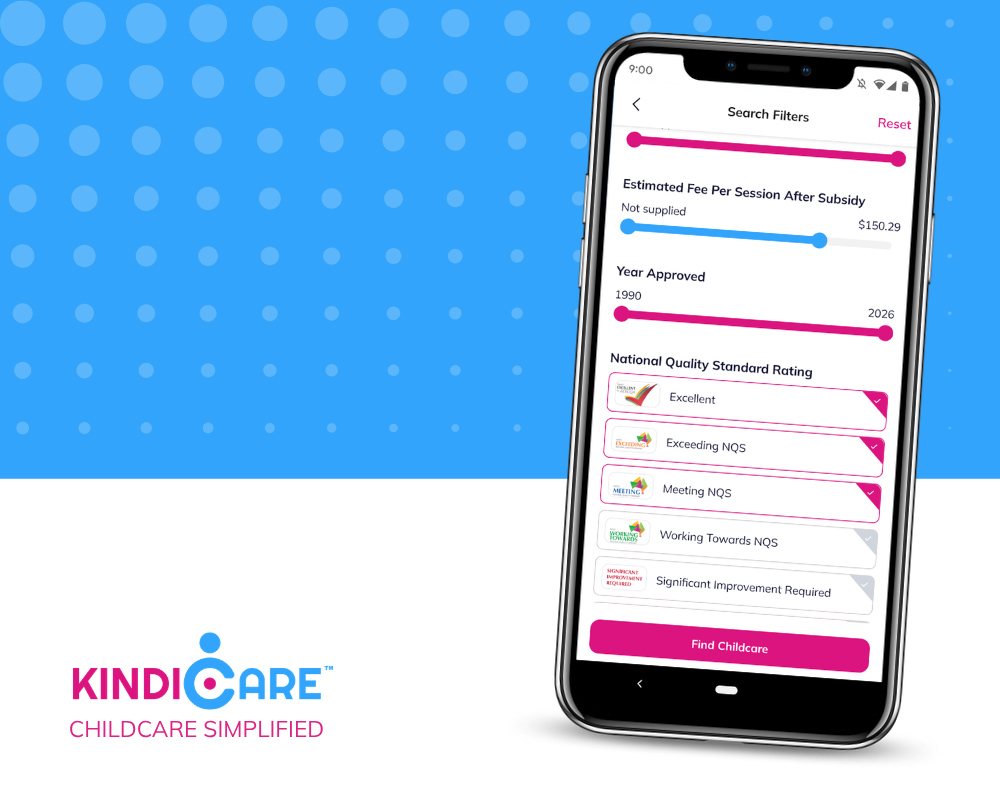
Then, once you've used the quality ratings to shortlist your favourite centres, keep thinking about the seven quality areas when touring each service
Look for signs that the centre is providing quality education and care.
And if you see play-based learning, clean and safe premises, interesting environments, qualified educators, happy interactions, and a Centre Director who’s dedicated to ongoing improvement, then you might want to apply promptly.
Or better still, ASAP!

FAQs
What is the childcare NQS rating
The National Quality Standard (NQS) is a national benchmark that Australian childcare services get assessed and rated against. Services get NQS ratings for seven quality areas, and one overall rating based on those results. There are five NQS ratings: Excellent, Exceeding NQS, Meeting NQS, Working Towards NQS and Significant Improvement Needed. Parents use NQS ratings to compare the quality of childcare services.
What is the KindiCare Rating
The KindiCare Rating enables Australians to compare the quality of childcare services. KindiCare gives each service a unique KindiCare Rating between NR (Not Rated) and 10. The higher the number, the better the service. The KindiCare Rating is updated as KindiCare receives new information about a service, so it’s a real time indicator of quality, performance and customer satisfaction.