


Fee Relief for Families
A family-friendly explanation of the 2022-2023 Budget.
BY HEJIRA CONVERY, KINDICARE
You don’t need to be an economist to know that Australia’s cost of living is off the chart right now and childcare fees are on a pretty scary trajectory.
Fees have risen 41% in the past eight years, and although it’s easy to point the finger at early learning providers, fees are a complicated business in these pricey times.

Providers are facing the same financial pressures as the rest of us, with ever-increasing rent, mortgage, utility and food costs which have to be factored into fees, plus they have the added pressure of chronic staff shortages, which mean they have to pay more to attract and retain quality people.
Fortunately, there is fee relief on the way for many families, thanks to the 2022-2023 Budget.
In it, the Albanese government recognises the immense pressure that our own budgets are under, and they’re committing $4.5 billion over four years to deliver cheaper childcare for around 1.26 million families.
Under the government’s Plan for Cheaper Child Care, Child Care Subsidy (CCS) rates will go up from 1 July 2023.
Assuming the legislation goes through, the government will:
- Raise the maximum CCS rate to 90% for families earning $80,000 a year or less
- Increase the CCS rates for about 96% of families with a child in care earning less than $530,000
- Increase subsidised early childhood education and care (ECEC) to a minimum of 36 hours a fortnight for families with First Nations children.
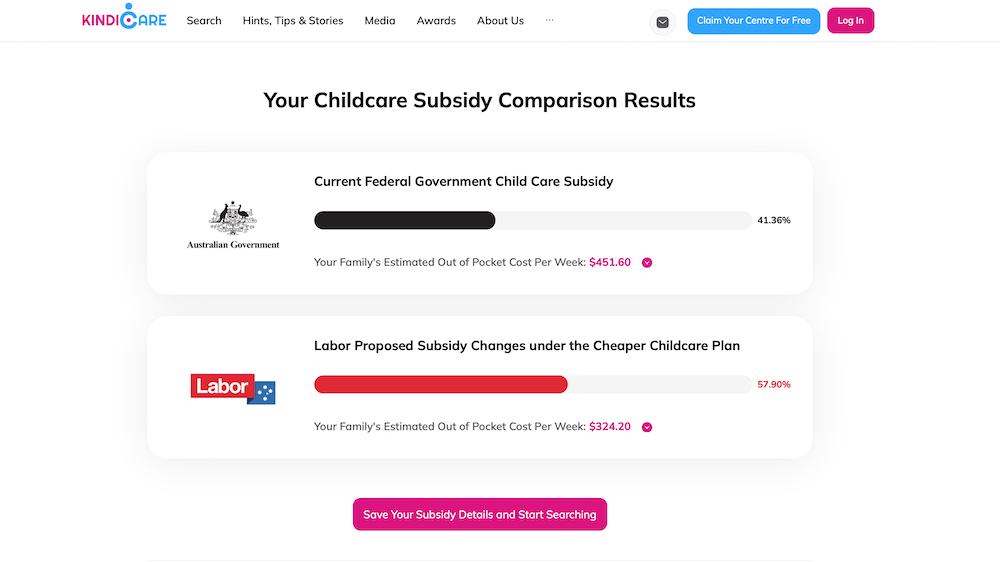
You can calculate exactly what you'll save with KindiCare's Subsidy Calculator >>>>
This all bodes well, but how will the Plan for Cheaper Child Care actually affect the fees we pay?
Well, there’s no one answer to this question, because every family has different CCS eligibility and childcare expenses, but as a guide, the government says, “A family on roughly the Australian median combined income of $120,000 with one child in care will save $1,780 in the first year of this plan.”
It’s also helpful to take a ‘before and after’ view of a few different CCS percentages.
For instance:
- A family with a combined annual income of $72,000, who’s currently entitled to an 85% CCS percentage, will receive a maximum rate of 90% from next July.
- A family earning $120,000 and getting a CCS of 71% now, will see their CCS percentage rise to 82%.
- And a family with more than one under-five in care who’s currently eligible to receive a higher subsidy for their younger child/ren will continue to get this assistance under the Plan for Cheaper Child Care.

The government says no family will be worse off come July 2023, and there’s also hope that every family will get a huge childcare discount in time.
The government is funding a year-long Australian Competition and Consumer Commission inquiry into ECEC prices to see what’s driving rising costs and ensure that its spending is targeted to the main causes of price rises.
This inquiry kicks off in January 2023, and its findings will contribute to a Productivity Commission review of the ECEC sector.
The end goal of this review is the implementation of a universal 90% subsidy for all families, which is something everyone can get excited about!
And that’s not all…
As part of its ‘five-point plan’ for cost-of-living relief, the government is expanding the Paid Parental Leave (PPL) scheme, increasing PPL to 26 weeks by 2026.
They’re also establishing a partnership between Australian governments and First Nations representatives to develop community-led policies and programs.
And if you’re worried that some ECEC providers aren’t playing fair when it comes to fees, you’ll be happy to know that the government is on top of this, too!
They’re putting in measures to protect the CCS against fraud and non-compliance, and are also requiring large providers to report their revenue, profits and commercial leasing info.

At KindiCare, we welcome the government’s plan for childcare, but recognise that fees aren’t the only problem when it comes to ECEC delivery.
Staffing is a serious challenge for providers, with too many people leaving the sector and too few coming in, and although we applaud the government’s plan to cut childcare costs, the cheapest childcare imaginable means nothing if there aren’t enough people to provide it.
Really, more money and support is needed for our early learning professionals.
KindiCare Founder and CEO, Benjamin Balk, says the government needs to support wage increases for our amazing educators, and encourage more people into the sector with study scholarships and attractive career pathways.
Mr Balk says, “There is a critical workforce shortage in the early learning sector, with providers restricting the number of places and days available to families in many cases because they don't have enough educators and teachers to meet minimum ratio requirements. With demand for early childhood education and care services only increasing, we need to see concrete action from federal and state governments to boost wages as well as provide more opportunities for existing educators and new entrants to the sector to receive career development, training and support.“
As a parent, it pays to understand all of this.
It’s still a while till the Plan for Cheaper Child Care comes in, but now’s a good time to thank your educators for the incredible work they do in supporting your child’s learning, development and future success. Because no matter what fees you’re paying, this contribution is priceless.
You can calculate exactly what you'll save under the changes to the child care subsidy with Labor's Cheaper Child Care Plan by using KindiCare's Subsidy Calculator >>>>